

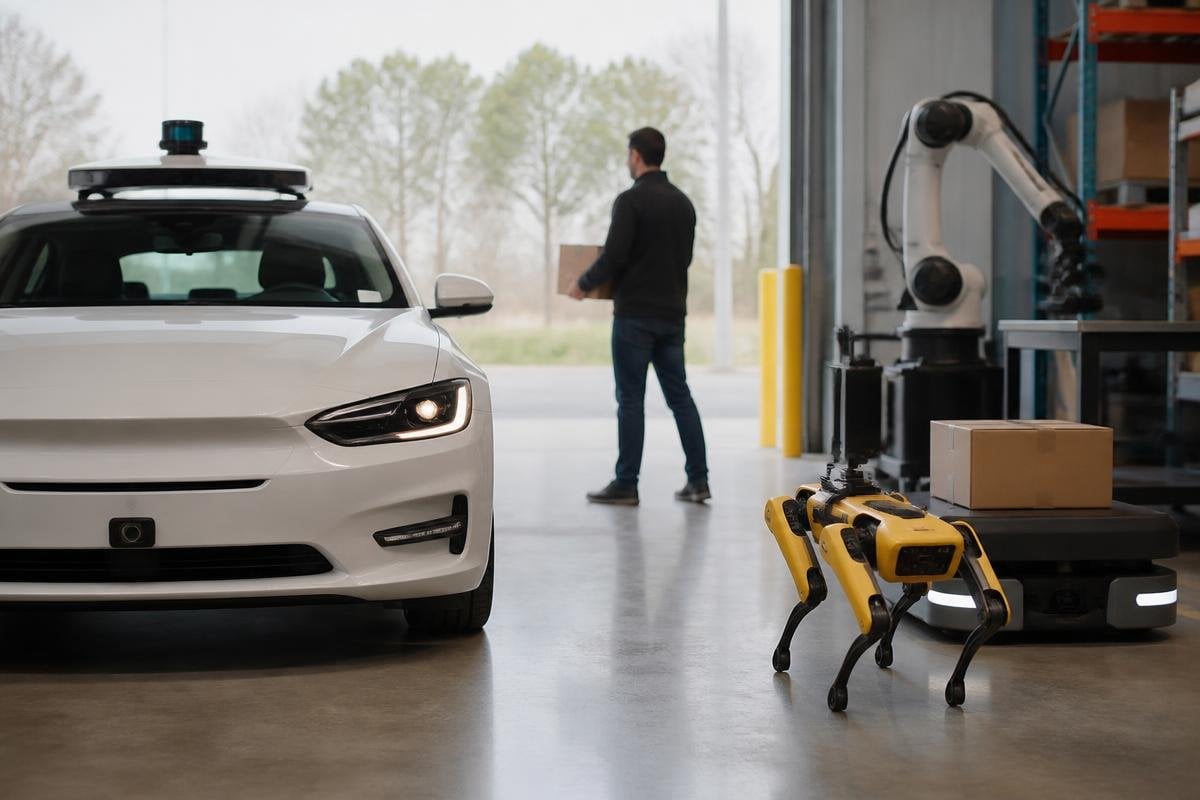
A self-driving car has to make a safe choice when its sensors disagree, its map is wrong, or a person behaves in an unexpected way. That same problem sits inside warehouse robots, delivery machines, and factory arms, where a failed handoff can stop work or injure someone.
Quick read
- Safe operation starts with a clear operating area
- Human handoff must be planned before the robot gets stuck
- Testing needs rare failures, not only normal tasks
Start with the operating area
Self-driving cars work within an operating design area: roads, weather, speeds, maps, and traffic rules the system is meant to handle. A robot needs the same boundary. A warehouse machine may work on flat floors under fixed lights, yet fail near a loading bay where glare, dust, or loose packaging changes what its sensors see.
That boundary should appear in the product plan and the safety instructions. If the robot cannot lift a box above a stated weight, reach beyond a set distance, or work on a wet floor, the operator needs that information before deployment. Clear limits make a smaller system more useful than a machine sold as ready for every site.
The lesson from cars is practical: define the job before judging the machine. A robot that handles one repeatable task well may be a better purchase than one that claims to handle a broad range of work without showing the conditions.
Plan the handoff before the failure
A car cannot ask a driver to take control without allowing time to understand the road. Robots face the same issue when a gripper drops a part, a route becomes blocked, or a camera loses sight of a package.
The handoff needs a clear signal, a safe pause, and enough information for a person to act. A screen that says “error” leaves the operator searching for the cause. A useful message names the failed task, the last safe position, and the action needed next.
Remote help can keep a robot moving, but it changes the work rather than removing it. Someone must watch alerts, decide when the robot should stop, and confirm that the area is safe.
That view also needs a record of what happened after the operator stepped in. Robot24.com autonomous systems coverage can help you compare remote-assistance claims with the site, task, and failure that prompted the call. Those details lead into the harder test: whether the system handles cases its plan didn’t cover.
Test the cases that break the plan
Normal operation is easy to film. The useful test starts when the plan meets an awkward case: a person steps into the path, an object has a new shape, a sensor gets blocked, or the robot reaches a place its map does not describe.
Car development points to a wider rule for robotics: a test set should include failures that are rare but costly. Engineers need to record what the machine saw, what it chose, how fast it stopped, and what a person had to do afterward. Without that record, a smooth demo says little about work across a full shift.
Simulation can add many test cases before hardware runs them. It cannot answer every question. Floor grip, lighting, cable damage, human movement, and worn parts can change the result on a real site. Physical tests still decide whether the machine behaves safely near people.
I’d favor a robot with a narrow job and a clear failure response over one with a wider claim and weak records.
A buying and deployment check
Use this list before a pilot reaches your site:
- Name the boundary: Write down the floor type, lighting, load range, speed, and spaces the robot may use.
- Watch the stop: Check what happens when a person blocks the route or a sensor loses its view.
- Test the handoff: Ask an operator to recover the robot without help from the maker.
- Record the evidence: Save logs, alerts, stop times, and the steps needed to restart work.
- Set a review date: Decide what result ends the pilot, extends it, or sends the machine back.
This process also changes how teams compare vendors. Ask for failure records and recovery steps beside the usual speed, payload, battery, and price figures. Those details tell you how much staff time the robot may need after the sales demo ends.
Autonomous cars have not removed uncertainty from autonomous machines. They have made one lesson hard to ignore: a robot earns trust by showing what it does when the plan breaks. The next useful test is the one your site can name before the robot arrives.
